Blue Note

Menu

The Finest In Jazz Since 1939
High Fidelity


News

News

March 4 2013

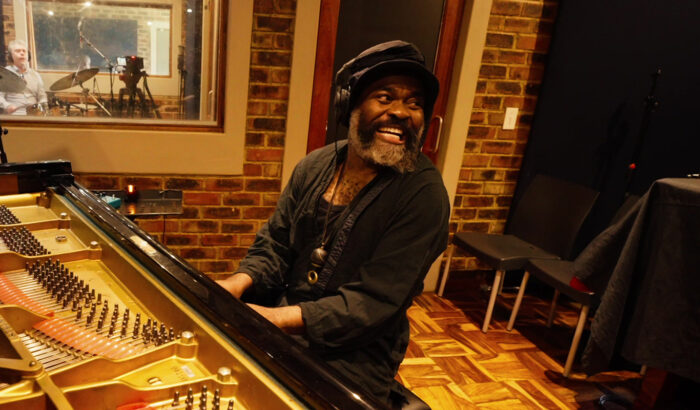
One evening in August of 1989, when the piano player Jason Moran was fourteen, he walked into his parents’ bedroom, in Houston, to ask a question. He found his mother and father sitting in front of the television. The sound was turned off, and a record was playing—Thelonious Monk, performing a solo version of his song “ ’Round Midnight,” which he recorded in 1957. “It’s a pensive song, and we were distraught,” Moran’s father, Andrew, told me. Someone they knew had died—it was the Texas congressman Mickey Leland, whose plane had crashed in Africa—and they were watching the story unfold.

Although no one said a word, Moran had the feeling that Monk, playing the piano, “was speaking,” he told me. Moran had studied piano since he was six, mostly to please his parents, using the Suzuki method, and he could play Bach and Chopin and Schumann. He had become reasonably accomplished, and had given recitals, but he had recently asked if he could quit. He liked hip-hop better. Hearing Monk’s austere music—“all the spareness and space”—he thought, The sounds I make on the piano do not sound like that. I need to do that. Whatever he does, I want to do. “As a young pianist, not knowing what’s involved in playing like that, you think, This may be attainable,” he said.

Andrew Moran remembers playing “ ’Round Midnight,” but he didn’t know that his son had encountered his future when he heard it. “That’s what moved him away from classical music into straight-ahead jazz?” he said. “I remember he got really heavy into Monk, and I noticed he was wearing a lot of hats.” A hallmark of Monk’s appearance was a succession of hats worn with a severe aplomb. . . .

February 28 2013

Multiple Grammy Award-winning artist Aaron Neville will be featured on CBS Sunday Morning on March 3rd. Journalist Anthony Mason visited Neville at the famous Electric Lady Studios in New York City for an in-depth interview in the same room that the soul/R&B legend recorded his first Top 10 album and highest charting set ever with his recent release, My True Story. The doo-wop inspired album was released on Blue Note Records and was co-produced by label President Don Was along with Keith Richards. Mason also tagged along with Neville in his hometown of New Orleans for an intimate and unique conversation about the singer’s career in music spanning over 50 years.

Starting on March 2nd, PBS will air the special Aaron Neville: Doo Wop: My True Story — a concert filmed in November at New York’s Brooklyn Bowl — throughout their March pledge campaign. The program features Aaron Neville performing songs from his album My True Story. An incredible array of musicians and guests will join Neville, including: Greg Leisz on guitar (Beck, Sheryl Crow, Bob Dylan, Ryan Adams), George G. Receli on drums (Bob Dylan, James Brown), Tony Scherr on bass (Bill Frisell, Norah Jones, Rufus Wainwright), Charles Neville on saxophone (Neville Brothers); Michael Goods on piano, Don Was on organ, Joel Katz, David Johnson and Earl Smith, Jr. on background vocals and, finally, special guests Paul Simon and Joan Osbourne.

Captured at the Brooklyn Bowl in November 2012, the concert featured special guests including Eugene Pitt of the Jive Five (who co-wrote the album's title song), and Dickie Harmon from the Del-Vikings. All of the songs on My True Story were hand-picked by Neville himself. They are songs that have remained close to his heart since he was a child. The selections include classics by vocal group giants such as Little Anthony and the Imperials ("Tears on My Pillow"), Hank Ballard and the Midnighters ("Work with Me Annie"), and the Drifters ("Money Honey," "Under the Boardwalk," "This Magic Moment"). To Neville though, these songs weren't just the soundtrack to his youth; they became the underpinning for all of the remarkable music he has created across five decades.

February 13 2013

PEOPLE, NYTIMES, USA TODAY, ROLLING STONE, NPR, RELIX, PARADE, WSJ, AND OTHERS PRAISE SOUL/R&B LEGEND’S ALBUM OF CLASSIC DOO-WOP COVERS

NEVILLE TO BE FEATURED ON NPR’S WORLD CAFE AND SONG TRAVELS ON FEBRUARY 14TH, AND THE LATE SHOW WITH DAVID LETTERMAN ON FEBRUARY 18TH

NEW SUMMER TOUR DATES ANNOUNCED

February 13th, 2013 — New York, NY — My True Story, the new album and Blue Note Records debut from Aaron Neville, has earned the soul/R&B legend and multiple Grammy Award-winning artist not only his first Top 10 album and highest-charting set ever, but also some of the best reviews of his career. A host of media outlets have weighed in on My True Story, which bowed at No. 7 on Billboard’s Top R&B/Hip-Hop Albums chart.

People magazine noted that “if ever there was an album that Aaron Neville was born to make, it’s this collection of doo-wop classics,” while Parade calls My True Story (which was produced by Blue Note Records President Don Was and Rolling Stones guitarist Keith Richards), “a heartfelt, tuneful tribute to two master musicians’ musical inspirations.” Rolling Stone said, “Welcome back to the sweetest falsetto in human history” and called Neville “a true soul master at work,” while USA Today raved that his “sweet tenor fits these doo-wop era standards like a glove.” American Songwriter calls the album “a thrilling project that combines Neville’s stunning voice with classic melodies whose sentiments remain timeless,” while Mojo says that “everything is perfectly suited to Neville’s achy-breaky falsetto, up there in the Smokey Robinson/Curtis Mayfield realm of delicious heartbreak and joy.”

In connection with the release of My True Story, Neville has made a series of high-profile appearances, including performances on The Today Show (watch here) and The Tonight Show With Jay Leno (watch here), a featured interview on NPR’s Morning Edition (listen here), and a sit-down interview on PBS’ Tavis Smiley (watch here). Neville also performed on WNYC’s Soundcheck (listen here), and was honored by the Grammy Museum, which celebrated his career with an intimate discussion and performance. Neville’s session for Yahoo! Music can be seen here, while his NPR “Free At Noon” concert can be heard here.


February 11 2013

THE NEW YORK TIMES

By WILLIAM YARDLEY
February 11, 2013


Donald Byrd, one of the leading jazz trumpeters of the 1950s and early 1960s, who became both successful and controversial in the 1970s by blending jazz, funk and rhythm and blues into a pop hybrid that defied categorization, died on Feb. 4 in Dover, Del. He was 80.

His death was confirmed by Haley Funeral Directors of Southfield, Mich. Word of Mr. Byrd’s death had circulated online for several days, but was not announced by his family.

Almost from the day he arrived in New York City in 1955 from his native Detroit, Mr. Byrd was at the center of the movement known as hard bop, a variation on bebop that put greater emphasis on jazz’s blues and gospel roots. Known for his pure tone and impeccable technique, he performed or recorded with some of the most prominent jazz musicians of that era, including John Coltrane, Thelonious Monk, Sonny Rollins and the drummer Art Blakey, considered one of jazz’s great talent scouts.

As a bandleader, Mr. Byrd was something of a talent scout himself: he was one of the first to hire a promising young pianist named Herbie Hancock — who, like Mr. Byrd, would later become known for a renegade approach that won a wide audience but displeased many critics.

Mr. Byrd, a strong advocate of music education, spent much of the 1960s teaching. Then, in 1973, he made a surprising transition to pop stardom with the release of the album “Black Byrd,” produced by the brothers Larry and Fonce Mizell, who had been his students at Howard University in Washington. With Mr. Byrd’s restrained trumpet licks layered over an irresistible funk groove seasoned with wah-wah guitar and simple, repeated lyrics (“Get in the groove, just can’t lose”), “Black Byrd” reached the Billboard Top 100, where it peaked at No. 88.

Mr. Byrd was hardly the first jazz musician to try such a crossover: Miles Davis had achieved a similar musical synthesis with “Bitches Brew” three years earlier. But “Black Byrd” was more overtly pop-oriented, and its success was extremely rare for a jazz musician. It became, and for a long time remained, the best-selling album in the history of Blue Note Records, the venerable jazz label for which Mr. Byrd had been recording since the 1950s.